Sherlock Holmes in New York (1976) TV Film Analysis
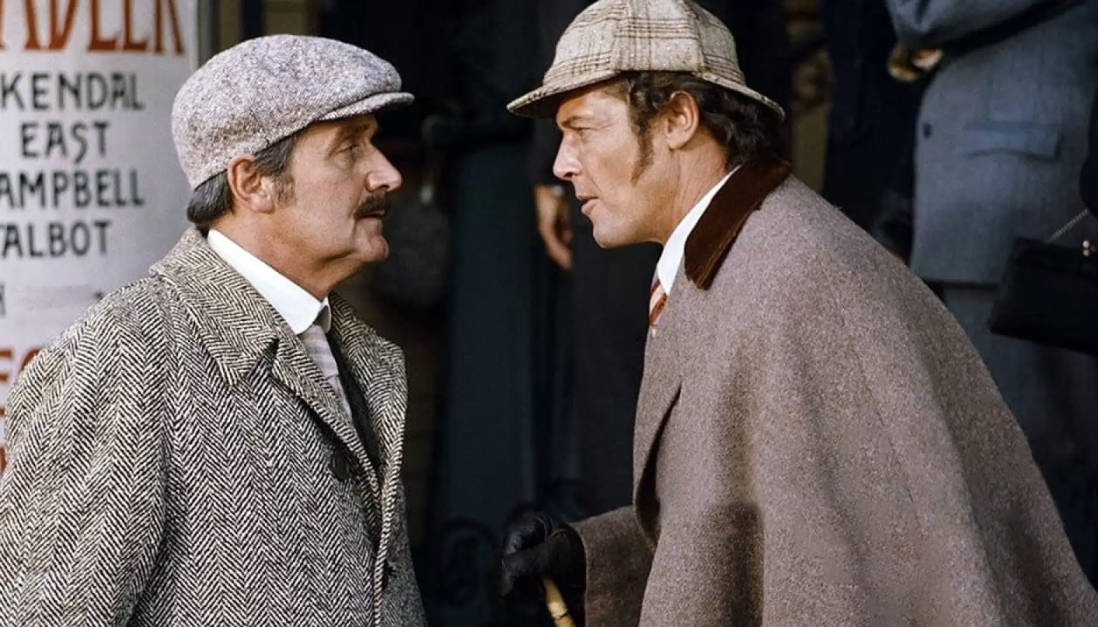
Sherlock Holmes in New York (1976): The Detective Goes West
The 1976 TV film Sherlock Holmes in New York offers a delightful and unique twist on the Sherlock Holmes mythos, transporting the iconic Victorian detective from his familiar London surroundings to the bustling streets of 1901 New York City. This fish-out-of-water premise provides ample opportunities for humor and cultural contrast, while still delivering a compelling mystery that showcases Holmes’ deductive abilities.
Production and Context
Produced for CBS, Sherlock Holmes in New York was part of a trend in the 1970s of adapting classic literary characters for television. The film was directed by Boris Sagal and starred Roger Moore as Sherlock Holmes, Patrick Macnee as Dr. John Watson, and John Huston as Professor Moriarty. The casting of Roger Moore, who was then playing James Bond in the cinema, added a touch of star power to the production.
The film was well-received upon its release, praised for its charm, humor, and the chemistry between its lead actors. It has since gained a cult following, particularly among fans of classic Sherlock Holmes adaptations and 1970s television.
Plot Analysis
The film begins in London, where Sherlock Holmes (Roger Moore) and Dr. John Watson (Patrick Macnee) are approached by Irene Adler (Charlotte Rampling), the only woman ever to outsmart Holmes. Adler, now married and living in New York, seeks Holmes’ help in recovering her kidnapped son, who has been abducted by Professor Moriarty (John Huston) as part of a larger scheme to steal the Bank of England’s gold reserves.
Holmes and Watson travel to New York City, where they must navigate the unfamiliar terrain of the Big Apple while investigating the case. They are assisted by Inspector Lafferty (David Huddleston), a gruff New York police detective who is initially skeptical of Holmes’ methods but gradually comes to respect his abilities.
As Holmes delves deeper into the case, he uncovers Moriarty’s elaborate plan to steal the gold, which involves smuggling it from England to America in barrels of oil. The tension builds to a climactic confrontation on board a ship, where Holmes must outwit Moriarty to recover the gold and rescue Adler’s son.
Character Interpretations
“Sherlock Holmes in New York” offers engaging interpretations of the classic characters, with the change of setting adding new dimensions to their personalities:
Sherlock Holmes (Roger Moore)
Roger Moore’s portrayal of Sherlock Holmes is distinctive, blending the character’s traditional intellect and eccentricity with Moore’s own suave charm.
Key character traits include:
- His deductive brilliance, which he applies to the unfamiliar New York setting
- His dry wit and occasional sarcasm, particularly when dealing with the cultural differences between London and New York
- His genuine concern for Irene Adler and her son, showing a softer side to his character
- His fish-out-of-water moments, such as his confusion with American customs and technology
- His unwavering determination to outwit Moriarty, even in unfamiliar surroundings
Moore’s Holmes is more debonair than some traditional interpretations, but he retains the core elements that make the character enduring.
Dr. John Watson (Patrick Macnee)
Patrick Macnee’s portrayal of Watson is equally engaging, providing a perfect counterbalance to Moore’s Holmes.
Key character traits include:
- His loyalty and devotion to Holmes, even in unfamiliar surroundings
- His practical approach to the case, which complements Holmes’ more cerebral methods
- His enthusiasm for the new experiences New York offers
- His occasional bewilderment at Holmes’ methods, which provides comic relief
- His bravery in the face of danger, particularly during the climactic confrontation with Moriarty
Macnee’s Watson is more active and resourceful than the traditional bumbling sidekick portrayal, making him a more compelling character in his own right.
Irene Adler (Charlotte Rampling)
Charlotte Rampling’s portrayal of Irene Adler brings depth and complexity to the character, who is often reduced to a one-note figure in other adaptations.
Key character traits include:
- Her intelligence and resourcefulness, which allow her to hold her own with Holmes
- Her vulnerability as a mother seeking to recover her kidnapped son
- Her complicated history with Holmes, which adds emotional depth to their interactions
- Her independence and strength, which make her a compelling character in her own right
Rampling’s Adler is more fully realized than in many adaptations, making her relationship with Holmes more meaningful and her plight more sympathetic.
Professor Moriarty (John Huston)
John Huston’s portrayal of Moriarty is commanding and charismatic, making him a formidable antagonist.
Key character traits include:
- His intelligence and strategic thinking, which match Holmes'
- His charm and sophistication, which mask his ruthless nature
- His elaborate scheme to steal the Bank of England’s gold
- His personal interest in Holmes, seeing him as a worthy opponent
- His willingness to use any means necessary to achieve his goals
Huston’s Moriarty is a worthy adversary for Holmes, making their confrontation all the more compelling.
Thematic Elements
“Sherlock Holmes in New York” explores several themes that are particularly highlighted by the change of setting:
Cultural Contrast
The film delights in contrasting Victorian London with Gilded Age New York, highlighting the differences in customs, technology, and social norms between the two cities. This contrast provides both humor and insight into the characters.
Nostalgia and Romance
The film has a strong nostalgic quality, both for the Victorian era and for the golden age of detective fiction. The relationship between Holmes and Irene Adler adds a romantic element that is often absent from Sherlock Holmes adaptations.
The Universal Nature of Detection
Despite the change in setting, the film emphasizes that Holmes’ deductive methods are universally applicable, demonstrating that his brilliance transcends time and place.
Loyalty and Friendship
The film celebrates the enduring friendship between Holmes and Watson, showing how their bond remains strong even in unfamiliar surroundings.
Visual Style and Cinematic Techniques
“Sherlock Holmes in New York” employs a visual style that captures both the charm of the Victorian era and the energy of Gilded Age New York:
- Production Design: The film’s sets and costumes beautifully recreate both Victorian London and 1901 New York, with particular attention to period detail
- Location Shooting: The film makes effective use of actual New York locations, including Central Park, the Brooklyn Bridge, and the docks
- Cinematography: The film employs a classical style of cinematography, with carefully composed shots that emphasize the contrast between the two cities
- Music: The film’s score, composed by Nelson Riddle, combines traditional orchestral elements with more contemporary sounds, reflecting the cultural contrast at the heart of the story
- Humor: The film uses visual gags and cultural misunderstandings to create humor, particularly in the scenes where Holmes and Watson navigate the unfamiliar New York landscape
Cultural Impact
“Sherlock Holmes in New York” has had a lasting impact on the Sherlock Holmes adaptation landscape:
- Setting Innovation: The film demonstrated that Sherlock Holmes stories could be effectively transplanted to different time periods and locations, paving the way for later adaptations like Elementary and the Robert Downey Jr. films
- Star Power: The casting of Roger Moore, Patrick Macnee, and John Huston helped to bring Sherlock Holmes to a wider audience
- Genre Blending: The film successfully blended elements of mystery, adventure, and comedy, showing the versatility of the Sherlock Holmes mythos
- Character Depth: The film’s exploration of Holmes’ relationship with Irene Adler added a new dimension to the character, influencing later adaptations
- Cult Following: The film has gained a dedicated fan base over the years, appreciated for its charm, humor, and the chemistry between its lead actors
Conclusion
“Sherlock Holmes in New York” is a delightful and innovative addition to the Sherlock Holmes adaptation landscape, offering a fresh take on the iconic detective by transporting him to a new setting. The fish-out-of-water premise provides ample opportunities for humor and cultural contrast, while still delivering a compelling mystery that showcases Holmes’ deductive abilities.
The film’s greatest strength is its cast, particularly the chemistry between Roger Moore’s suave Holmes and Patrick Macnee’s dependable Watson. Charlotte Rampling’s Irene Adler and John Huston’s Moriarty also deliver memorable performances, adding depth and complexity to the story.
“Sherlock Holmes in New York” proves that the Sherlock Holmes mythos is flexible enough to accommodate different settings and interpretations, while still retaining the core elements that make these stories enduring. By transporting Holmes to a new time and place, the film offers a fresh perspective on the character and his methods, demonstrating that his brilliance transcends time and location.
Image Suggestion
- Image location:
/static/images/ - Image name:
sherlock-holmes-in-new-york-1976.jpg - Suggested content: A promotional still of Roger Moore as Sherlock Holmes and Patrick Macnee as Dr. John Watson standing in front of the Brooklyn Bridge, with Holmes holding his iconic deerstalker hat and pipe